
Reviewed · UNESCO WORLD HERITAGE TOURS
Old Kathmandu Walking Tour, Historic World Heritage Durbar Square
Kathmandu reveals itself best on foot, one courtyard and shrine at a time. This private 4 to 5-hour walk links the old city’s market lanes with Buddhist monasteries, Hindu temples, Kathmandu Durbar Square, and Kumari Chowk, where you may see Nepal’s living goddess.
I like the way the route mixes famous sights with places most first-time visitors would miss, especially Bikramshila Mahavihar and Itum Bahal. I also like the relaxed finish at Cafe Mitra, where you can sit with your guide over tea or coffee and sort out what you have seen.
The main consideration is that entry fees for Kathmandu Durbar Square and the Swayambhu-related stupa complex are not included. You should also expect uneven streets, crowded market areas, and a morning of steady walking rather than a leisurely sightseeing bus ride.
Key points at a glance
- Old Kathmandu beyond the headline sights: Visit small monasteries, courtyards, shrines, and public spaces that are easy to miss on your own.
- Asan Bazaar in the morning: See one of Kathmandu’s oldest working markets, where locals shop for food, household items, clothing, metal goods, and religious objects.
- Kathmandu Durbar Square and Kumari Chowk: Explore the former royal square and the home of Kumari, Nepal’s living goddess.
- A private outing: Only your group participates, with private transportation and pickup available from tourist-town Thamel.
- A useful cultural mix: Buddhist and Hindu sites appear side by side, giving you a quick way to understand Kathmandu’s shared religious life.
- Tea and conversation at the end: Finish at Cafe Mitra with a drink and an informal talk with your guide.
Why this walk makes sense early in your Kathmandu stay
This is the kind of tour I would choose near the start of a Kathmandu visit. It gives you a practical map of the old city, explains the religious customs you will keep seeing, and shows how daily life works around the monuments.
The route begins at 9:00 a.m. from Amrit Marg in Thamel. If you are staying in the main tourist area, pickup can begin at your hotel lobby. If you are outside that zone, the operator can collect you and drive you to the starting point, with the transfer described as roughly 20 minutes.
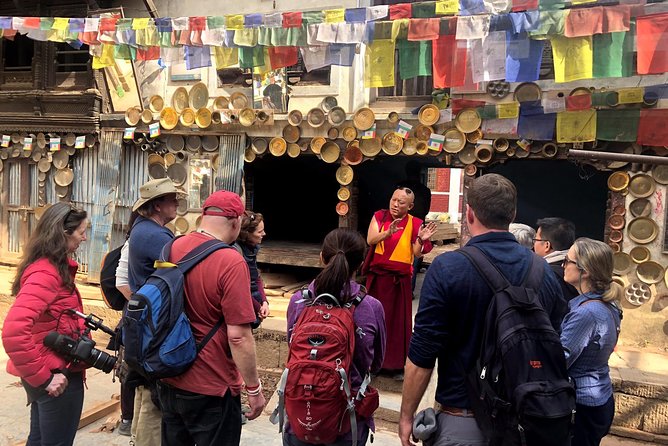
The private format matters here. Old Kathmandu can feel confusing, with narrow lanes leading to courtyards that are not obvious from the street. With only your own group, you can ask questions, pause at a shrine, or spend extra time on a detail without waiting for a large party.
Guides named in the experience include Mahesh Shreshtha and Modo. The guide is central to the value of the walk. The temples and bahals, or traditional monastery courtyards, are worth seeing on their own, but their meaning is much easier to grasp when someone points out the connections between Newar Buddhist traditions, Hindu worship, royal history, and neighborhood life.
More UNESCO World Heritage Tours in Kathmandu:
- Private Kathmandu Sightseeing Tour | UNESCO World Heritage sites
★ 5.0 · 756 reviews - Kathmandu: Full Day 7 UNESCO Tour with Lunch – Private/Group
★ 5.0 · 415 reviews - Kathmandu: Full Day Top 4 UNESCO Tour with Lunch – Private/Group
★ 5.0 · 269 reviews
Bikramshila Mahavihar, the monument behind Thamel’s name
Your first stop is Bikramshila Mahavihar, also called Thambahil. This old Buddhist monument belongs to the native Newar community and receives far fewer tourists than the major sites later in the walk.
The connection to Thamel gives the stop extra interest. The tourist district takes its name from this historic monument, so you begin by looking beneath the modern hotels, restaurants, and trekking shops to find the older Kathmandu that was here first.
You have about 15 minutes at the site, with no admission charge. That is enough for an introduction rather than a long study. Pay attention to the courtyard setting and ask your guide how the monument relates to local Buddhist practice.
This is a good early stop because it changes your view of Thamel. The neighborhood is not only a base for visitors. It sits within an older religious and residential part of Kathmandu.
Asan Bazaar, where Kathmandu does its daily shopping
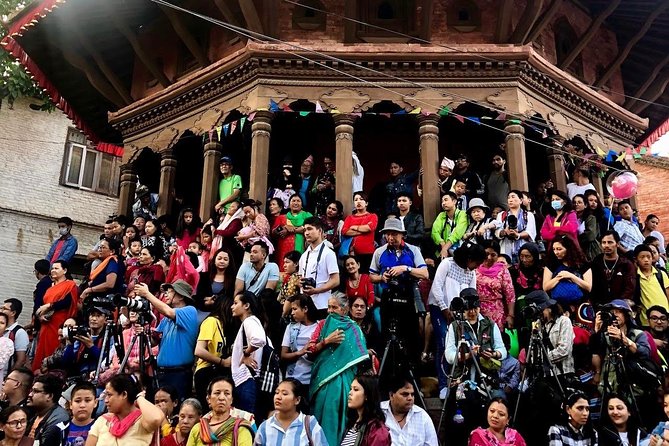
From there, the route reaches Asan, one of the oldest living markets in Kathmandu. This is not a market arranged for sightseeing. Local people come here for vegetables, clothing, metal items, household goods, and spiritual objects.
The 15-minute stop is short, so you will not have much time for an extended shop or a long photo session. That is not necessarily a problem. The purpose is to see the market in motion and understand how trade, worship, and neighborhood life overlap.
Asan can be crowded, so keep your belongings secure and stay close to your guide. The narrow streets are part of the experience, but they can also make it hard to keep track of your group.
I like this stop because it gives the tour some ordinary life between the monuments. Kathmandu is not a museum city. People carry on with shopping, prayer, work, and conversation around buildings that may be centuries old.
Janabaha Dyo and the many faces of compassion
The next stop is Janabaha Dyo, also known as the Seto MachhindraNath Temple. This shrine honors a native deity of Kathmandu who is also known in Tibetan Buddhist tradition as Avalokitesvara, the god of compassion.
The shrine contains 108 engraved images of Avalokitesvara, representing different forms. That detail gives you something specific to look for instead of simply walking through another ornate religious site.
You have about 15 minutes here. Local devotees visit the shrine, so treat it as an active place of worship. Your guide can help you understand what you are seeing and explain the shared connections between local Newar belief and Tibetan Buddhist tradition.
This short stop works well for visitors who want more than architecture. It shows how the same religious figure can carry meaning across different communities and traditions.
More Durbar Square Tours in Kathmandu:
- Bhaktapur & Patan Durbar Square Day Tours
★ 5.0 · 122 reviews - Kathmandu Sunset Tour by Rickshaw Including Durbar Square Visit
★ 5.0 · 73 reviews - City tour of Bhaktapur and Patan Durbar Square
★ 4.5 · 20 reviews - Bhaktapur Old City and Durbar Square Half-Day Tour
★ 5.0 · 15 reviews
Itum Bahal, a courtyard hidden in plain sight
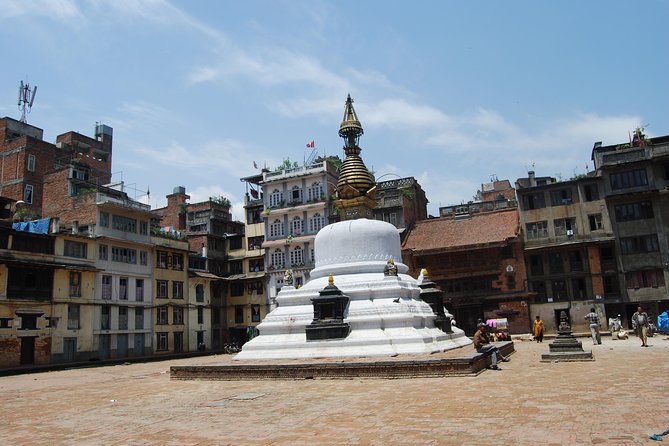
Itum Bahal receives a longer visit, around 30 minutes. The site was once one of the largest Buddhist monasteries in ancient Kathmandu, and the 11th-century complex still contains part of its original monastic structure.
The courtyard includes shrines connected with the goddess Tara. You may find this more rewarding than a quick pass through a major monument because the space feels tied to the surrounding neighborhood rather than separated from it.
This is where a local guide can make a clear difference. Bahals are easy to miss if you walk quickly through the old city. From the street, an entrance may look modest. Inside, the courtyard can open into a much larger religious and social space.
The stop also prepares you for Kathmandu Durbar Square. You will have already seen that Kathmandu’s sacred places are not limited to grand towers or royal buildings. Some of the city’s most meaningful spaces are tucked behind ordinary lanes.
Kathmandu Durbar Square, the royal heart of old Kathmandu
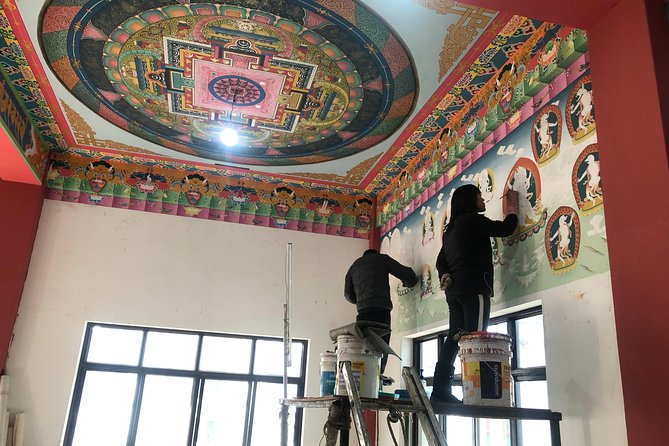
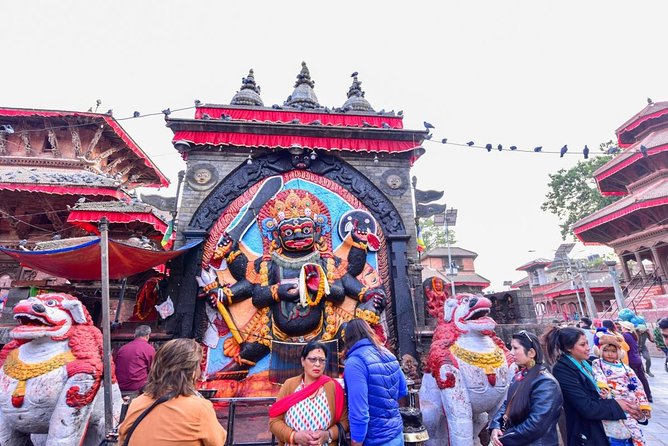
The route then reaches Kathmandu Durbar Square, the former palace area of Nepal’s kings. The square is known for traditional Nepali art and architecture, with temples and palace buildings grouped around open public spaces.
You have about 45 minutes here, making it the longest major sightseeing stop. That gives you time to take in the scale of the square and listen to the stories behind the buildings without rushing through the area.
The entrance fee is not included, so budget separately for admission. The same applies to the Swayambhu-related stupa complex later in the walk. The supplied tour details do not state the current fee, so check the price when booking or at the entrance rather than assuming it is covered by the $28 tour price.
Durbar Square is the most recognizable part of the route, but it is not the only reason to book this walk. On your own, you could see the main buildings and take photographs. The guide adds value by tying the square to the temples, markets, courtyards, and living traditions you saw earlier.
The 2015 earthquake changed parts of Kathmandu’s heritage areas, and restoration work can affect what you see. No specific construction schedule is provided for this experience, so expect that some buildings or views may vary on the day.
Kumari Chowk and the living goddess
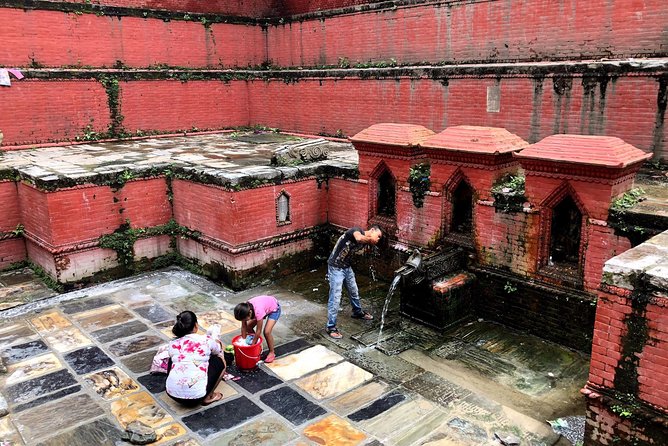
Within Durbar Square, the tour continues to Kumari Chowk, a roughly 300-year-old artistic building and the home of Kumari, Nepal’s living goddess. You have about 20 minutes here.
Seeing Kumari is not guaranteed. If you are fortunate, she may appear at the window or courtyard opening. The possibility is part of the experience, but you should not treat it as a scheduled performance.
The building itself deserves attention. Its carved woodwork is a fine example of traditional Nepali design, and the visit gives you a direct look at how religious belief, royal tradition, and public life meet in Kathmandu.
Follow your guide’s instructions about photography and behavior. This is a sacred home, not simply a tourist attraction. The best approach is quiet attention and respect, whether or not Kumari appears.
This stop received particularly strong praise in the available feedback, along with the guide’s explanations at Durbar Square and Asan Bazaar. The combination of a major royal site, a small living religious tradition, and the chance to see Kumari is likely to be the morning’s most memorable section.
Kathesimbu and a smaller stupa tradition
After Durbar Square, the route moves through the old town toward the Buddhist stupa complex of Kathesimbu, also called Dharmakirti Vihara. The supplied schedule does not give a separate duration for this stop, but it is part of the walk between the square and Thamel.
The complex contains a replica of Swayambhu Stupa, one of Nepal’s most important Buddhist pilgrimage sites. You will need to pay the applicable entry fee for the Swayambhu Stupa-related premises, since it is not included.
Kathesimbu offers a useful contrast with Durbar Square. The royal square is broad and monumental. This Buddhist complex gives you a more intimate sense of how religious sites fit into the old city’s lanes and courtyards.
The walk between sites is important. You are not simply being driven from one attraction to the next. You pass through the old town, where shrines, homes, shops, and historic structures share tight urban space. Wear comfortable shoes and expect the route to feel more like city walking than a smooth park stroll.
Tea at Cafe Mitra gives the morning a natural finish
The tour ends at Cafe Mitra on Thamel Marg, back in the tourist district. You receive tea or coffee and have around 30 minutes to talk casually with your guide about the morning.
I like this ending because it gives the tour room to breathe. After several religious sites and a steady walk, you can ask about anything that remained unclear, from the role of the Newar community to the meaning of the shrines you passed.
A drink is included. Food is not listed as included, so do not count on a meal. The operator can drop participants at their hotels if they are outside the stated meeting-point area, but the confirmed end point is Cafe Mitra.
What the $28 price really gets you
At $28 per person, this is a modestly priced private experience for a half-day in central Kathmandu. The value comes from the guide, the private transport, the route through smaller sites, and the amount of ground covered without having to plan each lane yourself.
The price does not cover entry to Kathmandu Durbar Square or the Swayambhu Stupa premises. That reduces the all-in value slightly, but the admission costs are separate heritage-site charges rather than a surprise inclusion that was quietly left out.
Group discounts are available, which may make the cost more attractive if you are traveling with family or friends. Since this is a private activity, you do not share the walking experience with unrelated participants.
The tour has a 5 out of 5 rating based on 22 reviews, with 100 percent recommending it. The most consistent praise centers on the mix of major sights and lesser-known lanes, the chance to see Kumari, and the guides’ ability to point out details that are easy to miss.
Specific guide names connected with the experience include Mahesh Shreshtha and Modo. If you have a preference, you can ask about guide availability when booking, though the information does not promise a particular guide.
Who should book this Kathmandu walk
I would recommend this tour to you if:
- You have only a short time in Kathmandu and want a strong introduction to the old city.
- You prefer walking through working neighborhoods over visiting only famous monuments.
- You want Buddhist and Hindu sites explained together.
- You like having a private guide instead of joining a large group.
- You want to see Kathmandu Durbar Square and Kumari Chowk but also visit smaller bahals and shrines.
- You appreciate a calm drink and conversation after sightseeing.
It may be less suitable if you dislike crowded lanes, uneven city streets, or religious sites where viewing a central figure is uncertain. It is also not the right choice if you want a slow, highly specialized architectural tour focused on one monument.
Most people can participate, according to the tour information, but no detailed accessibility statement is provided. If you have mobility concerns, ask before booking about the walking surface, steps, and access at each site.
The experience requires a minimum number of participants to operate. If that minimum is not met, you are offered another date or experience, or a full refund. You can cancel for a full refund up to 24 hours before the local start time. Changes or cancellations inside that window are not accepted.
Should you book the Old Kathmandu Walking Tour?
Book it if you want one morning that explains Kathmandu through both its grand monuments and its ordinary streets. The route is especially useful on a first visit because it gives you the cultural background to recognize shrines, bahals, markets, and temples during the rest of your stay.
The strongest reasons are the private format, the small Buddhist sites, the visit to Kumari Chowk, and the chance to ask questions over tea at the end. Add the entry fees to your budget, wear practical shoes, and keep your expectations realistic about seeing Kumari.
For $28 per person, this is a good-value way to get your bearings in old Kathmandu without reducing the city to a checklist of palace squares.
FAQ
How long does the Old Kathmandu Walking Tour last?
The experience lasts approximately 4 to 5 hours.
What time does the tour start?
The tour starts at 9:00 a.m.
Where does the tour begin?
The listed starting point is Amrit Marg in Kathmandu, Nepal. Pickup is offered from hotels in Thamel.
Is hotel pickup available outside Thamel?
The tour can pick you up and drive you to the starting point if you are outside tourist-town Thamel. The transfer is described as approximately 20 minutes.
Is this a private tour?
Yes. Only your group participates in the activity.
Are admission fees included?
No. Entry fees for Kathmandu Durbar Square and the Swayambhu Stupa premises are not included.
Is tea or coffee included?
Yes. Tea or coffee is included, and the tour ends with a drink at Cafe Mitra.
Can I see Kumari, the living goddess?
You visit Kumari Chowk, her home, but seeing Kumari is not guaranteed. The tour information says you may see her if you are lucky.
Can I cancel for a refund?
You can cancel up to 24 hours before the local start time for a full refund. Cancellations or changes made less than 24 hours before the start are not accepted.
More Walking Tours in Kathmandu
- Kathmandu Food and Drink Walking Tour
★ 5.0 · 266 reviews - Kathmandu: Food and Drink Walking Tour
★ 4.9 · 119 reviews - Walking Street Food Tour in Kathmandu
★ 5.0 · 111 reviews - Walking Food Tour in Hidden Local Eateries of Kathmandu
★ 5.0 · 40 reviews
More Historical Tours in Kathmandu
- UNESCO Seven World Heritage Tour in Kathmandu
★ 5.0 · 253 reviews - Kathmandu Private Sightseeing Tour | UNESCO World Heritage Sites
★ 5.0 · 109 reviews - Kathmandu: Full Day Private Top 4 UNESCO Heritage Tour W/Lunch.
★ 5.0 · 86 reviews - Kathmandu World Heritage Tour
★ 5.0 · 74 reviews
Just added around Kathmandu
- Private Half-Day Tour of Boudhanath and Pashupatinath Temples in Kathmandu★ 4.5 · 9 reviews
- Private Half-Day Tour of Kathmandu Durbar Square and Swayambhunath Temple★ 4.5 · 11 reviews
- Namobuddha Monastery Hiking Day Tour via Panauti from Kathmandu★ 5.0 · 15 reviews
- Private Full-Day Kathmandu City Tour★ 5.0 · 9 reviews
- Private Day Tour in Kathmandu Valley Rim with Bhaktapur Sightseeing★ 5.0 · 3 reviews
- Private Half Day Budhanilkantha Tour★ 5.0 · 6 reviews
- Private Day Tour: Patan and Bhaktapur from Kathmandu★ 4.5 · 6 reviews
- Private Day Tour – Sacred Journey to Namo Buddha★ 5.0 · 5 reviews
UNESCO World Heritage Tours, compared.
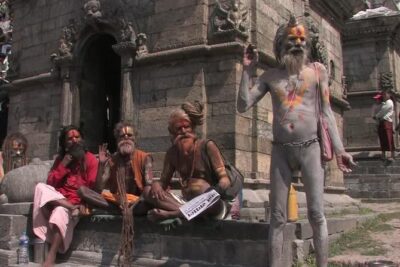
Private Kathmandu Sightseeing Tour | UNESCO World Heritage sites
Read our review →
Full Day 7 UNESCO Tour with Lunch – Private/Group
Read our review →
Full Day Top 4 UNESCO Tour with Lunch – Private/Group
Read our review →
Kathmandu Spiritual Sites: Bodhnath & Pashupatinath Tour
Read our review →
Kathmandu Private Sightseeing Tour | UNESCO World Heritage Sites
Read our review →Full Day 7 UNESCO Tour with Lunch – Private/Group
Read our review →Browse the lists this tour appears in