
Reviewed · ANNAPURNA CIRCUIT TREKS
Annapurna Circuit Trek with Tilicho Lake (16 Days)
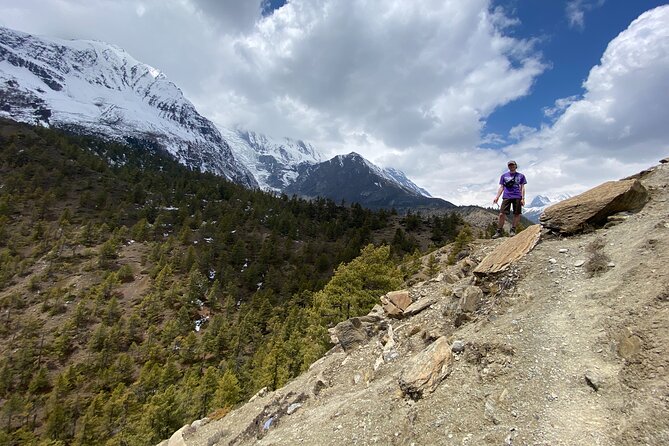
The big draw is the high-altitude double act: Tilicho Lake at 4,919 meters, followed by Thorong La Pass at 5,416 meters. You get forests, stone villages, dry Himalayan valleys, pilgrimage sites, and the Kali Gandaki corridor in one long trip rather than a short out-and-back walk.
I like the planned acclimatization day in Manang and the extra assistant guide ratio of one for every five hikers. I also like the mix of private and public transport, which keeps the price at $1,800 while still covering airport transfers, hotels, porters, permits, and the main road transfers.
The main caution is that this is a serious high-altitude trek, not a gentle holiday walk. Meals during the trek, drinking water, personal gear, hot showers, Wi-Fi, charging, tips, insurance, and possible emergency costs are extra. The long road sections can also be rough and tiring.
Key points to know before booking
- Tilicho Lake reaches 4,919 meters, making it one of the highest lakes you can reach on foot.
- Thorong La Pass rises to 5,416 meters, with a strenuous early climb from Thorong Phedi.
- Manang includes a full acclimatization day, with three possible hike options chosen with your guide.
- Porter support follows a two-to-one ratio, so each porter carries the overnight bags of two hikers.
- The group is capped at 14 people, with one assistant guide for every five hikers.
- The route ends in Pokhara, with a hotel night beside Phewa Lake before returning to Kathmandu.
Why this Annapurna route earns its reputation
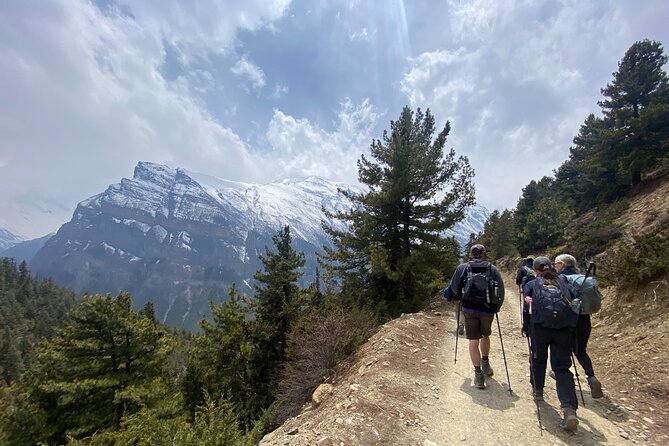
I like the Annapurna Circuit because the scenery changes almost every day. You begin near green river valleys and pine forest, move through Tibetan-influenced villages, reach bare high-altitude country, and then descend into the dry valleys of Mustang.
Adding Tilicho Lake makes the route harder but also more distinctive. The detour takes you away from the main circuit and into a remote basin beneath steep, glacier-cut slopes. You then return toward the classic pass crossing instead of simply following the standard circuit.
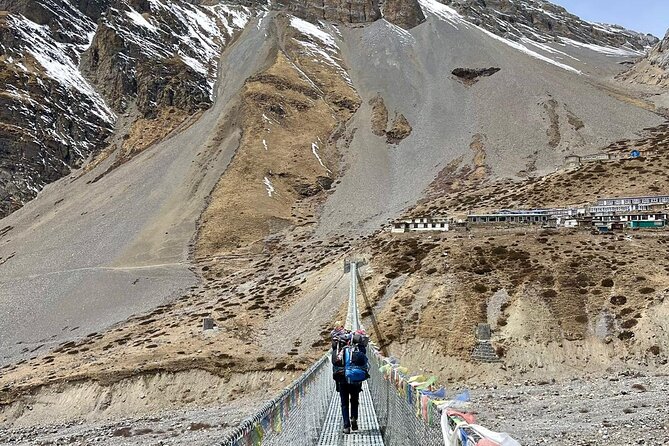
The cultural side matters as much as the views. You pass through Gurung, Manangi, and Thakali communities, with Buddhist chortens, prayer flags, stone houses, old monasteries, and Hindu and Buddhist pilgrimage sites along the way. The route feels like a journey across several parts of Nepal, not just a mountain climb.
More Annapurna Circuit Treks in Kathmandu
- Annapurna Circuit Trek with Tilicho Lake
★ 5.0 · 368 reviews - Annapurna Circuit Trek
★ 5.0 · 94 reviews - Annapurna Circuit Trek
★ 5.0 · 35 reviews
Days 1 and 2: Kathmandu to Dharapani
Your trip begins with an airport pickup at Tribhuvan International Airport and a transfer to a three-star hotel in Thamel. This first day is useful for getting settled, meeting the team, and checking your gear before the mountain road begins.
The second day is mostly about transport. A private vehicle takes you toward Besisahar, passing along the Trishuli River and through Mugling, a major road junction where buses, trucks, tea stalls, and snack vendors crowd the route. These stops are practical rather than polished, but they give you a quick look at everyday road travel in Nepal.
Besisahar, at about 760 meters, is the usual starting point for the Annapurna Circuit. From there, a shared jeep carries you to Dharapani at 1,960 meters. This is a long day, listed at about 12 hours, and road conditions can make the journey feel longer.
Dharapani marks the real beginning of the trek. It sits in the Marsyangdi Valley among pine forests and high ridges. You should expect a basic mountain village, not a resort town. The advantage is that you reach the trailhead without spending an extra walking day on lower roads.
Days 3 and 4: Pine forests, Chame, and Upper Pisang
From Dharapani, you walk through Bagarchhap, a small settlement known for whitewashed houses, Buddhist chortens, and pine-covered slopes. This is where the architecture and religious details begin to feel more Tibetan in character.
The route continues toward Chame, the administrative center of Manang District, at 2,670 meters. The walking day includes forest, river views, and a steady gain in height. Chame has more facilities than the smaller villages, which makes it a useful overnight stop before the route becomes more remote.
Day 4 brings you through Bharatang, a narrow rest point beside the Marsyangdi River. Apple orchards and small juice farms make it a pleasant pause before the trail reaches Pisang.
Upper Pisang sits at about 3,300 meters above the river, with broad views toward Annapurna II and Pisang Peak. The higher village has traditional Tibetan-style buildings and a more dramatic setting than the lower route. If your legs are feeling the altitude, this section can be demanding because the trail gains height while the air gets noticeably thinner.
Days 5 and 6: Manang and the value of a rest day
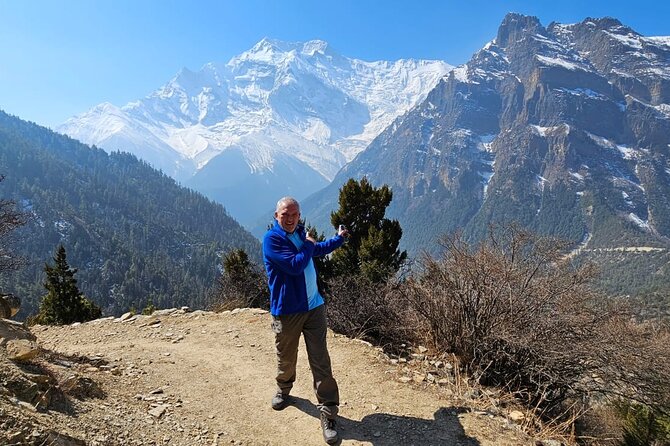
The route to Manang can be taken by a high trail through Ghyaru and Ngawal. These old stone villages give you a stronger sense of the Manang Valley than simply following the lower road. The reward is better mountain scenery, but the high route also requires more effort.
Manang sits at approximately 3,540 meters and is the cultural center of this section of the circuit. Annapurna III and Gangapurna frame the valley, while local buildings, shops, monasteries, and teahouses give the town a lived-in feel rather than a purely trekking-stop atmosphere.
Day 6 is a scheduled acclimatization day in Manang. This is one of the best features of the plan. Instead of rushing upward, you spend a night at the same altitude and choose one of three acclimatization walks with your guide: a short, steep climb, a moderate outing, or a longer option. The exact choice depends on your condition and the guide’s advice.
You should take this day seriously. Resting does not mean doing nothing, and pushing too hard does not make you fitter for the pass. A controlled walk, plenty of fluids, and a close check on how you feel are more useful than trying to prove your strength.
Same mountains, a completely different kind of day:
- Everest Base Camp Trek – 14 Days
★ 5.0 · 1,499 reviews - Private Kathmandu Sightseeing Tour | UNESCO World Heritage sites
★ 5.0 · 756 reviews - Everest Base Camp Helicopter Tour landing at Everest View Hotel
★ 5.0 · 668 reviews - Half day cooking class in Thamel kathmandu
★ 5.0 · 607 reviews
Days 7 to 9: The Tilicho Lake detour
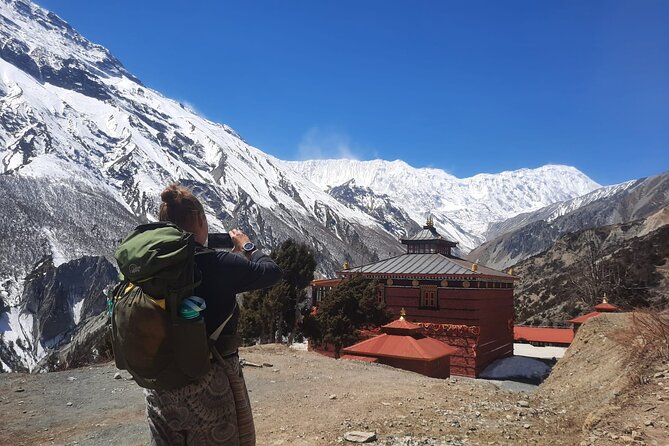
After Manang, the route turns toward Siri Kharka at about 4,060 meters. The trail climbs through juniper shrubs and reaches a high ridge with views of Gangapurna and the Chulu range.
Siri Kharka is remote and basic. That is part of its appeal, but it also means fewer comforts. You should be ready for simple teahouse accommodation, limited hot water, and possible extra charges for charging devices or using Wi-Fi.
The next day takes you to Tilicho Base Camp at around 4,150 meters. The walk is not especially long on paper, but it can feel intense because the path crosses exposed, landslide-prone ground below steep cliffs. Your guide’s pace and attention matter here. Keep your hands free, watch your footing, and do not treat this as a casual sightseeing walk.
The climb to Tilicho Lake is the payoff. At 4,919 meters, the lake lies in a stark basin surrounded by snow-covered peaks, including Tilicho Peak. You only have a listed 45-minute stop at the lake, so the day is built around reaching the viewpoint, taking in the setting, and returning safely rather than spending hours at the shoreline.
The lake is sacred in both Hindu and Buddhist traditions. That adds meaning to the place, but you should also remember the practical side: the air is thin, weather can change quickly, and the return walk still requires energy. This is one of the days when a slow pace is the smart pace.
Days 10 and 11: Returning to the main trail
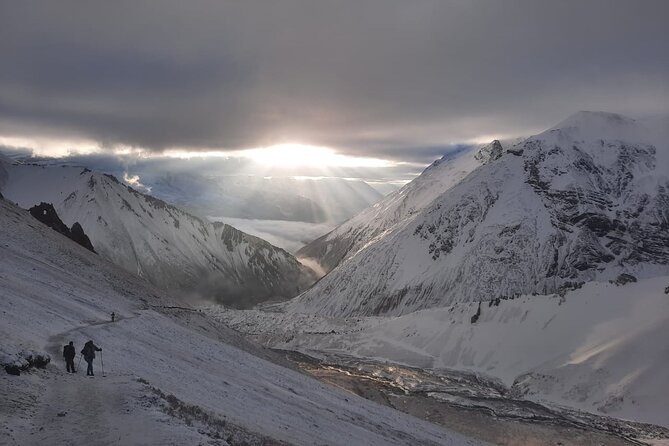
After the Tilicho section, the route descends from Siri Kharka toward Khangsar and then climbs again toward Yak Kharka. Yak Kharka sits at roughly 4,050 meters and serves as a staging point for the pass.
This part of the itinerary can feel awkward because you lose some height and then regain it. That is normal for the route. It also gives your body another gradual transition before the higher overnight stop.
From Yak Kharka, you continue to Thorong Phedi at 4,540 meters. The trail crosses bare, dusty ridges with little shelter. Thorong Phedi is the final base before the pass and is a functional stopping point rather than a place to linger.
The next day usually requires an early start. The climb from Thorong Phedi gains more than 900 meters before reaching Thorong La, so you need warm clothing, a headlamp if your guide recommends an especially early departure, and enough water for the climb. Those items are not listed as supplied, so prepare them yourself.
Day 12: Thorong La and the descent to Muktinath
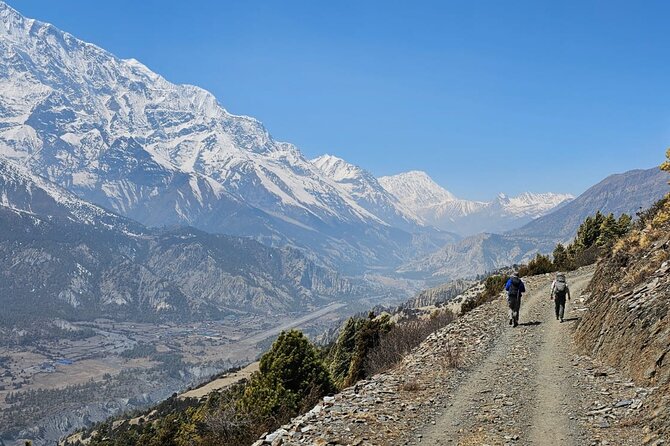
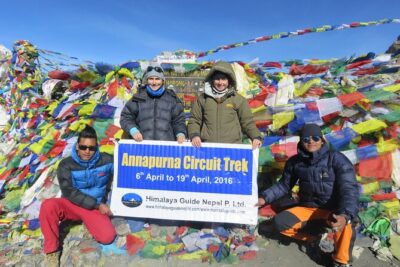
Thorong La Pass reaches 5,416 meters, the highest point of the trek. The ascent is physically demanding, but the sense of crossing from the Manang side into Mustang makes the effort worthwhile.
The pass itself is exposed and often windy. Take your photographs, but keep the stop sensible. At this altitude, standing around for too long can leave you cold and drained.
From the pass, the trail drops roughly 1,600 meters to Muktinath at 3,760 meters. That descent is a relief for breathing, but it is hard on knees and thighs after the morning climb. Trekking poles can be useful, though personal trekking gear is not included.
Muktinath is an important pilgrimage town for both Hindus and Buddhists. The setting also changes sharply here, from the greener upper Marsyangdi side to the dry, open valleys of Mustang. This is one of the strongest transitions on the whole route.
Days 13 and 14: Kagbeni, Jomsom, and the road to Pokhara
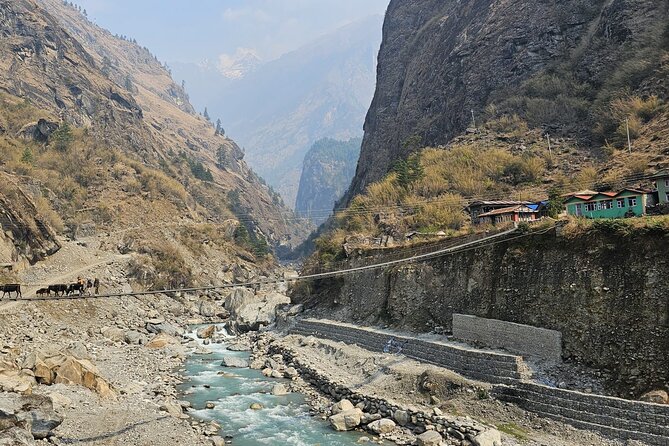
The trail continues to Kagbeni at 2,810 meters, an old settlement at the meeting point of the Kali Gandaki and Jhong rivers. Its narrow stone lanes, red-walled monastery, and position at the gateway to Upper Mustang give it a distinctive character.
From Kagbeni, you follow the Kali Gandaki toward Jomsom at 2,720 meters. The valley is known for strong winds, especially later in the day, so an early start can make the walking more comfortable. Jomsom is the administrative center of Mustang and an important transport point.
Day 14 shifts from trekking to road travel. A public bus takes you through Kalopani, one of the greener villages in Mustang, and onward to Beni at about 850 meters. The scenery becomes greener as you descend, but the ride may be rough and slow on mountain roads.
From Beni, the route continues toward Pokhara. You arrive at Lakeside Pokhara, where a three-star hotel and breakfast are included. After days of walking and basic teahouses, this night beside Phewa Lake is a welcome change.
Days 15 and 16: Pokhara recovery and departure
Day 15 gives you time in Pokhara before the tourist bus returns to Kathmandu. Pokhara is framed by the Annapurna range and Machapuchare, and the lakeside area is the most relaxed part of the trip.
The bus journey to Kathmandu covers about 200 kilometers along the Prithvi Highway. It is another long road day, listed at about 12 hours. This is not a scenic flight or a quick transfer, but it keeps the package cost lower and avoids adding a domestic flight to the plan.
Back in Kathmandu, your transport from the bus park to the hotel is included. On Day 16, the team takes you to the airport according to your flight time. If you have a few spare hours, Thamel is handy for cafés and last-minute shopping.
What the $1,800 price really covers
At $1,800 per person, the package offers solid value for a 16-day high-altitude trek, especially if you want organized support rather than arranging each road transfer and teahouse yourself.
Included services cover:
- Airport pickup and drop-off
- Private transport from Kathmandu to Besisahar
- Shared jeep transport to Dharapani
- Public bus from Jomsom to Pokhara
- Tourist bus from Pokhara to Kathmandu
- Three-star hotels with breakfast in Kathmandu and Pokhara
- Standard teahouse accommodation during the trek
- A licensed, first-aid-trained trek guide
- Porter support at two hikers per porter
- One assistant guide for every five hikers
- Annapurna Conservation Area and TIMS permits
- Crew insurance and government-related arrangements
- A trek completion certificate
The transport mix is important. Private transfers handle the early logistics, while shared and public vehicles cover the mountain roads. You get convenience at the points where it matters most, without paying for a private vehicle throughout.
The package does not include most trekking meals. Only three breakfasts and two dinners are listed, which correspond to the hotel stays and welcome or farewell arrangements. Budget separately for breakfast, lunch, dinner, snacks, and drinks during the walking days.
You also need travel insurance that covers the highest altitude reached and emergency evacuation. Government fees are listed separately at $50 per person, despite a separate reference to government fees being included, so confirm this charge before payment. Also set aside money for hot showers, charging, Wi-Fi, drinking water, tips, gear, extra nights, weather delays, or rescue costs.
Guides, group size, and support
The maximum group size is 14 people. That is small enough for a guide to keep track of the group, though it is not a private trek. A group of this size can also move more slowly, especially on the pass day.
The staffing plan is reassuring. You have a professional government-licensed guide with first-aid training, porters carrying overnight bags, and one assistant guide for every five hikers. The company team has included staff named Raj Rai, Suman, Prashant, Prem, and Pemba Sherpa on its Nepal treks, but your specific guide should be confirmed before departure.
The strongest practical benefit is the organization. Pre-arrival communication, airport pickup, hotel transfers, teahouse arrangements, and porters reduce the number of small decisions you must manage. On a trek this long, that support is worth real money.
Who should book this trek
This trip suits you if you already have good physical fitness and want a full Himalayan route with two major high points. It is especially appealing if you value varied scenery, local villages, mountain culture, and a planned acclimatization schedule.
It is less suitable if you want luxury lodging, flexible private transport, short walking days, or fully covered meals. You also need to be comfortable with teahouses, basic facilities, public buses, and the possibility of weather-related changes.
Before booking, ask for a full packing list, the exact meal plan, the name of your assigned guide, the treatment of the $50 government fee, and the company’s procedure for altitude illness or evacuation. Those answers will help you judge the package more accurately than the headline price alone.
Should you book the Annapurna Circuit with Tilicho Lake?
I would choose this trek if you want the classic Annapurna Circuit but also want the extra achievement of Tilicho Lake. The route is well paced on paper, the Manang acclimatization day is a sensible safeguard, and the guide, assistant guide, porter, permit, and transfer arrangements offer useful support.
I would not choose it if you are new to strenuous hiking or expect every meal and comfort to be included. For a fit hiker who accepts basic teahouses, long road journeys, and extra costs, this is a strong-value way to cross Thorong La and reach one of Nepal’s most remarkable high lakes in the same trip.
FAQ
How long is the Annapurna Circuit with Tilicho Lake trek?
The experience lasts approximately 16 days, including arrival and departure in Kathmandu, the trek, transport days, and a stay in Pokhara.
What is the highest point on the route?
Thorong La Pass is the highest point at 5,416 meters. Tilicho Lake reaches 4,919 meters.
Is airport pickup included?
Yes. Airport pickup and drop-off in Kathmandu are included, along with hotel transfers connected to the bus journeys.
What type of accommodation is provided?
You stay in a three-star hotel with breakfast in Thamel, Kathmandu, and in Lakeside, Pokhara. During the trek, accommodation is in standard teahouses.
Are meals included during the trek?
Meals during the trek are not included. The package lists three breakfasts and two dinners, covering the hotel stays and welcome or farewell arrangements.
What happens if poor weather cancels the experience?
If poor weather causes cancellation, you can choose a different date or receive a full refund. The experience also requires a minimum number of participants, and the same options apply if that minimum is not reached.
More Hiking & Trekking in Kathmandu
- Everest Base Camp Trekking
★ 5.0 · 485 reviews - Nagarkot Sunrise View and Day Hiking from Kathmandu
★ 5.0 · 471 reviews - Everest Base Camp Trekking – 13 Day
★ 5.0 · 365 reviews - Everest Base Camp Trek -14 Days
★ 5.0 · 321 reviews
Just added around Kathmandu
- Private Half-Day Tour of Boudhanath and Pashupatinath Temples in Kathmandu★ 4.5 · 9 reviews
- Private Half-Day Tour of Kathmandu Durbar Square and Swayambhunath Temple★ 4.5 · 11 reviews
- Namobuddha Monastery Hiking Day Tour via Panauti from Kathmandu★ 5.0 · 15 reviews
- Private Full-Day Kathmandu City Tour★ 5.0 · 9 reviews
- Private Day Tour in Kathmandu Valley Rim with Bhaktapur Sightseeing★ 5.0 · 3 reviews
- Private Half Day Budhanilkantha Tour★ 5.0 · 6 reviews
- Private Day Tour: Patan and Bhaktapur from Kathmandu★ 4.5 · 6 reviews
- Private Day Tour – Sacred Journey to Namo Buddha★ 5.0 · 5 reviews
Annapurna Circuit Treks, compared.
15-Day Private Annapurna Circuit Trek from Kathmandu
Read our review →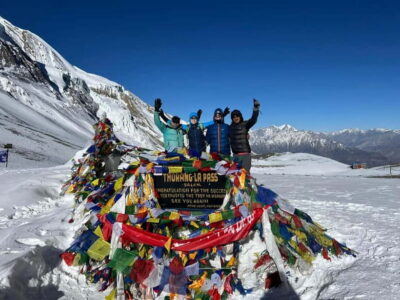
Browse the lists this tour appears in