Reviewed · FULL-DAY
KATHMANDU FULL DAY SIGHTSEEING TOUR (6-hrs)
Kathmandu’s great strength is variety: in one carefully packed day, you move from the sacred courtyard of Pashupatinath Temple to the 365 steps of Swayambhunath, then on to Patan and the broad mandala form of Boudhanath. The tour gives you a quick but meaningful look at both Hindu and Buddhist traditions, with a guide explaining the symbols rather than leaving you to guess.
I like the private vehicle, which saves you from managing Kathmandu traffic and lets your own group set the pace within the six-hour schedule. I also like the English-speaking guide, especially when you get someone such as Dip, whose engaging explanations can turn a string of monuments into a connected story. The main drawback is that this is a full day of major sights, and admission fees are extra, so the advertised $40 price is not the final cost.
Key points before you book
- Four major sights in about six hours: Pashupatinath, Swayambhunath, Patan Durbar Square, and Boudhanath are all included.
- A genuinely private outing: Only you and your group participate, rather than being added to a large coach party.
- Air-conditioned transport all day: This matters when you are moving between sites through Kathmandu traffic.
- The 365-step climb needs steady legs: Swayambhunath includes a full stair climb to the top.
- Admission fees are separate: Budget roughly $26 in total for the listed monument and museum fees.
- English-speaking guide and driver: Strong guiding and safe navigation are central to the experience.
What six hours in Kathmandu really gives you
This is not a slow, wandering city tour. It is a compact route through four important places, with roughly two hours assigned to Pashupatinath, one hour at Swayambhunath, two hours in Patan Durbar Square, and one hour at Boudhanath.
That schedule makes sense if your time in Nepal is short, or if you want an orientation before spending later days on your own. You will see a lot, but you will not have unlimited time for every shrine, courtyard, shop, or photo stop.
The private format helps. You do not have to wait for strangers at every entrance, and your guide can focus on the interests of your group. Still, four stops in six hours is an ambitious plan. Traffic, crowds, time spent paying entrance fees, and the pace of the stair climb can all affect how long you actually have at each site.
The start time is 9:30 am. Pickup is offered, and the vehicle remains available for the entire tour. The air conditioning is a practical benefit, not a luxury detail, since you are repeatedly getting in and out of the car during a busy sightseeing day.
A few more Kathmandu trips to weigh up
- Kathmandu: Full Day 7 UNESCO Tour with Lunch – Private/Group
★ 5.0 · 415 reviews - Kathmandu: Full Day Top 4 UNESCO Tour with Lunch – Private/Group
★ 5.0 · 269 reviews - Kathmandu: Full-Day 7 UNESCO Tour with Lunch – Private/Group
★ 4.9 · 247 reviews
Pashupatinath Temple, two hours of Hindu symbolism
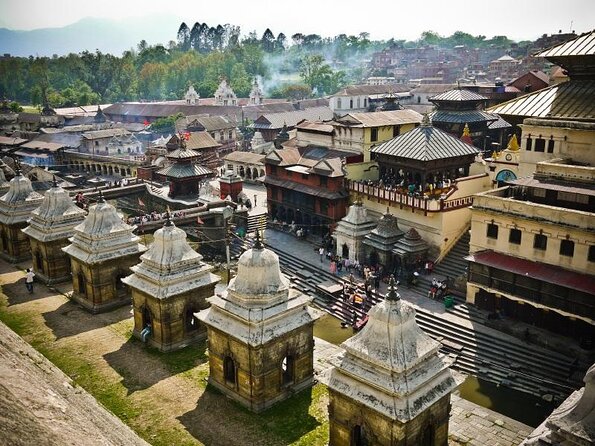
Pashupatinath is scheduled as the longest stop, and that is sensible. The temple sits in the town of Deopatan, in an open courtyard, and its main structure is a square, two-tiered pagoda on a single-tier plinth.
Your guide’s role matters here. The site is full of religious meaning, and the tour specifically focuses on the symbolism connected with the temple. Without explanation, you may notice the architecture but miss why the forms, spaces, and religious details matter.
Two hours gives you time to look beyond the main building. You can listen to the guide, study the courtyard, and take in the contrast between old sacred architecture and the modern city around it. The tour description does not promise a particular ceremony or special access, so you should treat this as a sightseeing and interpretation visit rather than a private religious event.
Pashupatinath is also a place where respectful behavior matters. Keep your attention on the guide’s instructions, follow any site rules, and remember that this is an active sacred place, not simply a photo stop.
Admission is not included. The listed estimate for city tour permits and monument fees totals about $10, $10, $4, and $2, or roughly $26 overall. The supplied information does not assign each figure to a particular stop, so carry enough local or accepted payment for the day rather than assuming the $40 covers every entrance.
Swayambhunath and its 365 steps
Swayambhunath is the most physically demanding part of the route. The visit includes climbing all 365 steps to the top, with small stupas and monkeys along the way. You are advised to pause as needed, which is good advice, since the climb is part of the visit rather than a minor detail.
The staircase gives this stop a different rhythm from the vehicle-based sightseeing elsewhere. You are moving under your own power, stopping for views and small religious structures instead of simply walking from a parking area into a monument.
At the top, the instructions are clear: circle the stupa clockwise, then visit the smaller temples and shrines. That clockwise circuit is an important part of how the site is experienced, and your guide can explain the religious symbolism as you go.
The allotted time is one hour. For someone comfortable with stairs, that can work, but it leaves little room for a long pause, extended photography, or a slow visit to every small shrine. If the climb takes you a while, keep an eye on the meeting time.
There is also a humorous practical warning in the description: vendors’ prices may rise as you climb. Take that as a reminder to ask the price before buying anything, especially when you are tired and eager to reach the top.
Admission is extra here too. Wear footwear that feels secure on steps and bring water if you normally need it during a climb. The tour includes transport and a guide, but it does not include a restroom on board, so use facilities when available at the stops.
Patan Durbar Square, two hours among temples
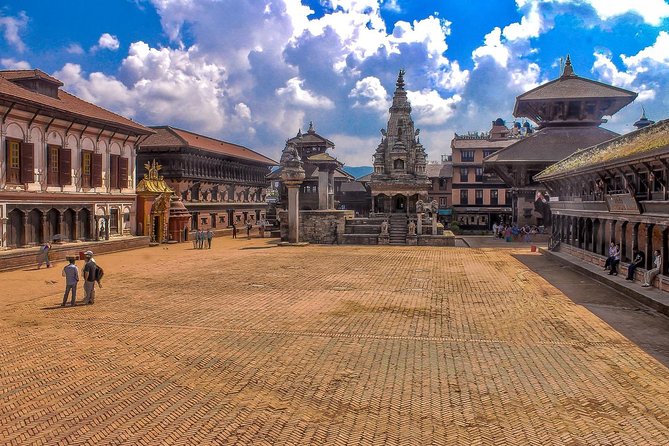
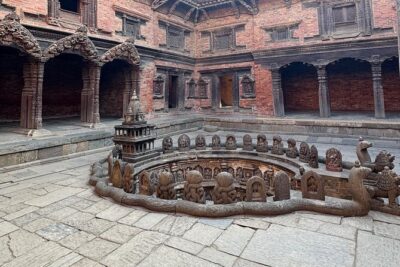
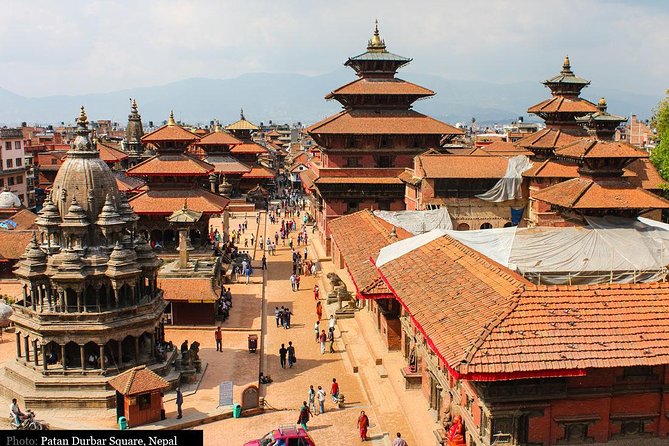
Patan Durbar Square receives another two-hour block, giving you more time to walk than you get at Swayambhunath or Boudhanath. The route begins on the left side of Patan, where you first see temples before moving deeper into the city.
One named attraction in the route is Chyasin Dewal. The visit is designed as a progression through the square, with the guide pointing out the main buildings rather than dropping you in the middle and leaving you to find your own way.
This is where the mixture of historical buildings and modern architecture becomes especially clear. The tour is not only about photographing temples. It is also about understanding how religious buildings, urban streets, and present-day city life sit close together.
Two hours is useful for Patan because a quick glance would flatten the place into a row of façades. You have time to walk, stop at the main attractions, and ask about the religious meaning behind what you see. If architectural detail interests you, this may be the stop where you most appreciate having a guide beside you.
The description lists several attractions but does not provide a full entrance breakdown. Plan on paying separately for permits and monument access, with the total estimated city fees around $26 across the day. Because fees can depend on the sites visited, confirm the exact amount with the operator before departure if your budget is tight.
Same mountains, a completely different kind of day:
- Everest Base Camp Trek – 14 Days
★ 5.0 · 1,499 reviews - Private Kathmandu Sightseeing Tour | UNESCO World Heritage sites
★ 5.0 · 756 reviews - Everest Base Camp Helicopter Tour landing at Everest View Hotel
★ 5.0 · 668 reviews - Half day cooking class in Thamel kathmandu
★ 5.0 · 607 reviews
Boudhanath Stupa and the Buddhist cosmos
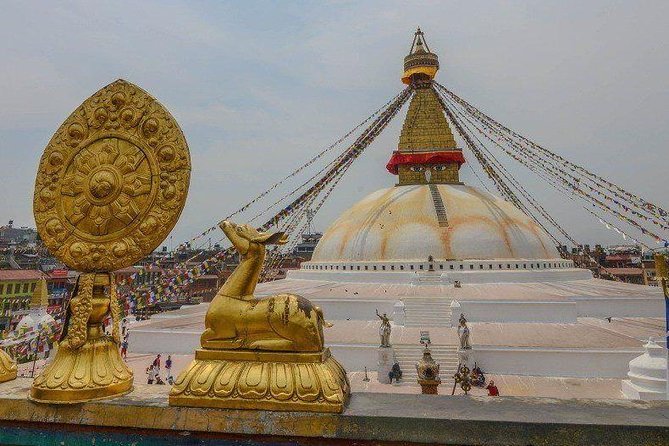
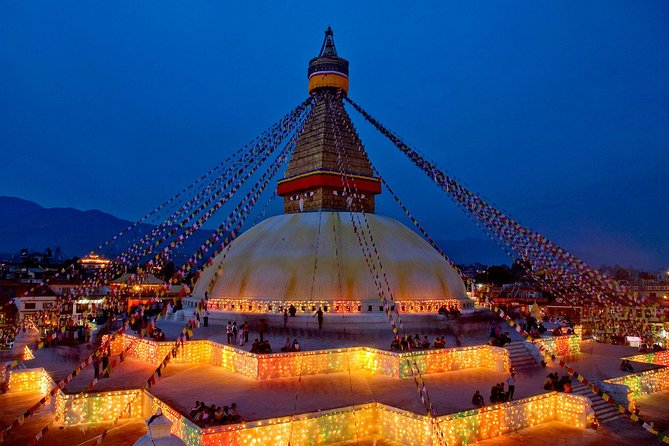
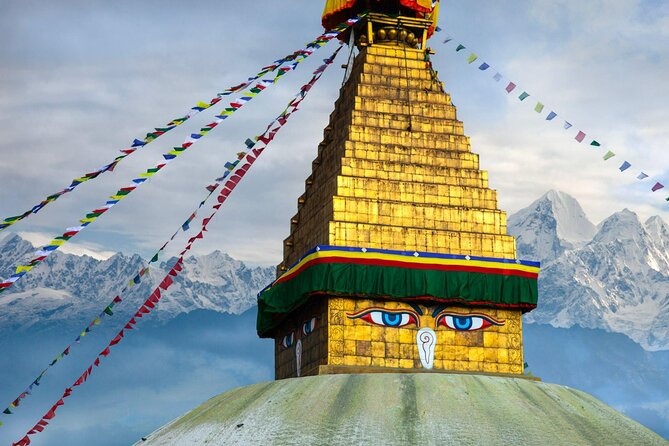
Boudhanath Stupa gets one hour, and the focus here is the stupa’s religious design. From above, it is described as a giant mandala, a diagram of the Buddhist cosmos, with four Dhyani Buddhas marking the cardinal points.
That detail gives you a useful way to look at the monument. Instead of seeing only a large white and gold structure, you can pay attention to its geometry and the way its parts relate to Buddhist ideas.
The visit is also a chance to circle the stupa clockwise, a pattern that echoes the instructions at Swayambhunath. Your guide will discuss the symbolism of Boudhanath and help connect the design to the wider religious traditions you have encountered earlier in the day.
One hour is enough for an introduction and a circuit, but not for an unhurried visit to every nearby shop or shrine. If you enjoy buying souvenirs, eating, or sitting with the view, you may need to choose between those activities and the guided sightseeing.
Like the other monuments, Boudhanath is not included in the tour price. Keep your schedule in mind, particularly if the earlier stops run long. The private vehicle gives you flexibility between sites, but the day still has a fixed start and an approximate six-hour length.
The guide and driver make the difference
The tour includes an experienced English-speaking guide and a driver. In a city known for difficult traffic, a capable driver is more than a convenience. You can concentrate on what you are seeing instead of trying to work out routes and negotiate every transfer yourself.
The guide can make the biggest difference at the religious sites. The advertised focus is not just on names and dates, but on significance and symbolism. A strong guide will help you understand why Pashupatinath, Swayambhunath, Patan, and Boudhanath belong in the same day while still representing distinct traditions and styles.
Dip is a named guide connected with this experience. His approach is described as engaging, and the company’s communication before the trip was reassuring in one particularly positive account. That does not guarantee that Dip will be assigned to your group, but you can ask about guide assignment when booking.
The private arrangement is best for couples, families, friends, or small groups who want their own vehicle and conversation. Group discounts are offered, so the per-person value may improve as your party grows. The supplied details do not state the maximum group size, so ask before booking if you need a specific vehicle arrangement.
Is $40 a fair price?
At $40 per person, this is a reasonable starting price for private transport, a driver, an English-speaking guide, and a six-hour route through four major sights. The value is strongest when you are sharing the vehicle with several people, since the private format gives your group service that would be harder to arrange independently.
The price needs a careful reading. All entrance fees and city permits are extra, with the listed estimates adding about $26. Lunch and dinner are also separate, although a meal is expected to cost about $3 to $6 depending on what and where you choose to eat.
That makes the practical sightseeing budget about $66 per person before food, assuming the listed entrance estimates apply to your visit. You are also responsible for personal expenses and anything you buy during the day.
One positive point is that government taxes are included. You are not paying for an air-conditioned vehicle, guide, and driver only to find a separate tax added later. The important question is how much you value saved planning time, private transport, and explanations at the monuments.
Lunch, comfort, and the small practical details
There is no restroom on board, so plan your comfort around the stops. The vehicle is air-conditioned, but that does not remove the need for sensible footwear and a little water for the 365-step climb.
Lunch is not included. The estimated cost is modest, between $3 and $6, and one good feature of a private tour is that you can discuss meal timing with your guide. The information does not promise a specific restaurant, menu, or included meal, so treat lunch as your own expense and choice.
Mobile ticketing and pickup make the beginning straightforward. Confirmation is received at booking, and the listed start time is 9:30 am. The tour is described as suitable for most people, but the full stair climb means anyone with limited mobility should think carefully about Swayambhunath before booking.
The tour requires good weather. If poor weather causes cancellation, you are offered another date or a full refund. You can cancel for a full refund up to 24 hours before the start time, but cancellations or changes inside that window are not accepted for a refund.
Who should book this Kathmandu tour?
I would choose this tour if you have one open day in Kathmandu and want the major religious and architectural sights handled in one private route. It is particularly useful at the start of a Nepal trip, when you want a guide to explain the city before exploring independently.
It also suits small groups that value a private vehicle, families that prefer not to share transport, and anyone who would rather pay for a guide than spend time arranging several separate visits.
I would hesitate if you want slow photography, long meals, shopping time, or detailed museum visits. The schedule is full, the entrance fees raise the real cost, and Swayambhunath requires a serious stair climb.
The tour earns its strongest marks for its guide and driver service. One account praised the guide’s explanations and the driver’s safe handling of Kathmandu traffic, while another praised the care shown from booking onward. There was also a complaint about confusion over cancellation and payment, so keep all payment terms clear in writing before the day begins.
Should you book it?
Book this Kathmandu sightseeing tour if you want an efficient, private introduction to four major sites and you are comfortable paying admission fees separately. At $40 per person, it can be good value for a group that wants air-conditioned transport and a guide who explains religious meaning instead of simply pointing out buildings.
Skip it, or choose a slower private itinerary, if you dislike packed schedules or cannot manage 365 steps. Before confirming, ask who your guide will be, what entrance fees will apply, and how lunch will fit into the six-hour plan. Those answers will tell you if this quick, well-organized overview matches your travel style.
FAQ
How long does the Kathmandu sightseeing tour last?
The tour lasts approximately six hours, beginning at 9:30 am.
Is this a private tour?
Yes. Only your group participates in the activity.
What sights are included?
The tour visits Pashupatinath Temple, Swayambhunath, Patan Durbar Square, and Boudhanath Stupa.
Are entrance fees included in the $40 price?
No. Monument permits and entrance fees are extra. The listed estimates total about $10, $10, $4, and $2.
Is transportation included?
Yes. The tour includes an air-conditioned vehicle and ground transport in a comfortable private vehicle.
Can I cancel for a full refund?
Yes. You can cancel at least 24 hours before the local start time for a full refund. Cancellations or changes made less than 24 hours before the start time are not accepted for a refund.
Just added around Kathmandu
- Private Half-Day Tour of Boudhanath and Pashupatinath Temples in Kathmandu★ 4.5 · 9 reviews
- Private Half-Day Tour of Kathmandu Durbar Square and Swayambhunath Temple★ 4.5 · 11 reviews
- Namobuddha Monastery Hiking Day Tour via Panauti from Kathmandu★ 5.0 · 15 reviews
- Private Full-Day Kathmandu City Tour★ 5.0 · 9 reviews
- Private Day Tour in Kathmandu Valley Rim with Bhaktapur Sightseeing★ 5.0 · 3 reviews
- Private Half Day Budhanilkantha Tour★ 5.0 · 6 reviews
- Private Day Tour: Patan and Bhaktapur from Kathmandu★ 4.5 · 6 reviews
- Private Day Tour – Sacred Journey to Namo Buddha★ 5.0 · 5 reviews
Full-Day, compared.
Full Day 7 UNESCO Tour with Lunch – Private/Group
Read our review →
Full Day Top 4 UNESCO Tour with Lunch – Private/Group
Read our review →
Full-Day Tibetan Cultural Tour to Tibetan Settlements Pokhara
Read our review →
Full-Day Sharing Bus Tour on 7 Iconic Destination
Read our review →
Full Day 7 UNESCO Tour with Lunch – Private/Group
Read our review →
Sarangkot Sunrise with Half or Full-Day City Tour
Read our review →